Sowing Rice Seeds
In the areas cultivated in our country, 15 kg per decare for small-grained varieties, 17–18 kg per decare for medium-grained varieties and 17-18 kg per decare for coarse-grained varieties. 20 kg/decare seed.
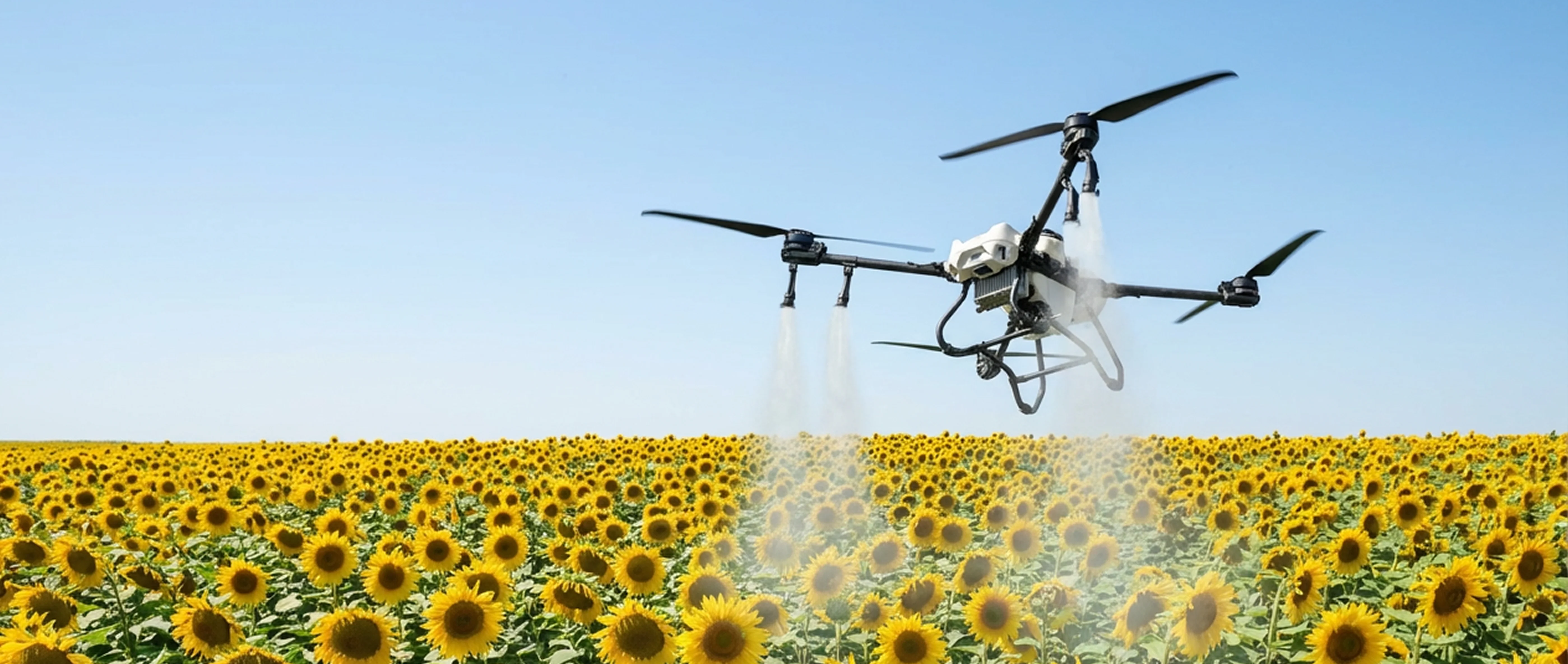
Baibars CT50s application parameters
According to the seed used, kg of seed per decare is written.
UAV speed should be: 5 m/s. Generally, the height is adjusted according to kg and an average height of 5 m is used.
An optimum of 5 take-offs are made with one battery. Seeds can be planted in an area between 10 and 15 decares in 10 minutes.
Paddy Fertilization
Baibars CT50s application parameters
Kg of seeds per decare is written according to the fertilization used.
UAV speed: 5 m/s
Usually the height is adjusted according to kg, an average height of 5 m is used.
An optimum 5 take-offs are made with one battery. Fertilization is done on an area between 10 and 15 decares in 10 minutes
Rice Blight Disease (Pyricularia oryzae Cav.)

Kimyasal mücadele
Chemical control is carried out against Rice Blight Disease in the form of seed and green parts spraying. Spraying time: Seed spraying should be done as a preventive measure. Spraying of green parts should be started immediately as soon as the first signs of the disease appear or if the weather conditions are suitable for the development of the disease. If necessary, a second or third spraying should be applied depending on the duration of effect of the drug and weather conditions.
Appropriate calibration and parameters depending on the pesticides used;
baibars CT33s baibars CT50s
Flight speed should be selected between 3-6 m/s and flight altitude 1-4 m.
Against the risk of drift during spraying. A safety strip of at least 4 m should be left and preferably anti-drift nozzles should be used.
In spraying with IHA, spraying should not be done at wind speeds above 2 m/s.
Green parts spraying: The medicated water prepared according to the recommended dose of the drug is applied to the field to provide a homogeneous coating on the surface of the leaves and stems.
Weeds
Spray species (Echinochloa spp.)
Bucket species (Cyperus spp.)
Dam Grass [Diplachne fusca (L.) P.Beauv. ex Roem. & Schult.]
Red Rice (Oryza sativa var. sylvatica)
Sedgewort species (Carex spp.)
Bottomgrass [Lindernia dubia (L.) Penne
Chemical control
Post-emergence herbicides should be applied in licensed dosages to dry and water.
In order to carry out chemical control in the control of red rice, varieties that are tolerant to IMI (Imidazoline) group herbicides should be planted.
In case cultural measures are not sufficient, pre-emergence or post-emergence drugs can be used.
In the fight against weed, pay attention to the cultivated crop plant in the neighboring field.
Low altitude should be preferred to minimize drift, especially at the edges of the field.
In herbicide application, weather conditions should be taken into account and application should be made in windless weather.
Herbicide should not be mixed with another pesticide.
Appropriate calibration and parameters depending on the pesticides used;
baibars CT33s
Height: 2.5 -3.0 meters 7.5-8.0 meters
UAV speed: average 5 m/s
Grasshoppers
Chemical Control
Disinfestation time After harmful grasshopper nymphs begin to appear in the reservation areas and the appropriate density is determined in the surveys, pesticide control is started immediately. Grasshoppers are in groups and less mobile during these periods.
If egg hatching pauses or starts again due to climatic conditions, field observations and controls should be continued, and if necessary, these areas should be sprayed again. Generally, chemical control is started against Moroccan Grasshoppers, Stubby Grasshoppers and Green Grasshoppers in April, against Black Grasshoppers and Italian Locusts in May, and against second-generation nymphs of Madrap Grasshoppers in July. However, fighting may occur earlier or at a later date, depending on geographical regions and climatic factors. Before deciding on chemical control against harmful locusts, nymph and adult surveys should be carried out in areas infested with locusts. In nymph survey, density is determined by the atrap method. The hoop diameter of the trap to be used should be 38 cm, the bag depth should be 76 cm, and the handle length should be 75 cm. The trap is shaken 10 times, once for each step, in 10 different parts of any contaminated area. After shaking every 10 traps, all nymphs belonging to harmful species are counted. 4th-5th grades in these areas. If instar nymphs are present, they are recorded as they are seen during the count. The count is made in 10 different places and the results are summed to find the total number of nymphs in 100 traps. 4th-5th in this total. The number of nymphs in the period is found.
The 4th-5th grades given on the scale. The numbers of period nymphs are minimum values. For example, if the number of nymphs in 100 traps is found to be between 300-350, for this density to be considered important, at least 75 of them must be in the 4th-5th stages. It must be a nymph during the period. When counting with an Atrap, the temperature must be above 18ºC and the wind speed must be below 10 km per hour. Under these conditions, the nymphs become active and enter the trap easily.
For the adult survey, the number of harmful grasshoppers in an area of 25x25 cm² is determined in 16 different places at intervals of every 15-20 steps in the area infested with grasshoppers. The sum of these gives the number of grasshoppers in 1 m². If there are 8 or more individuals in 1 m², chemical control is decided.
baibars CT33s
Height (altitude): 4 meters
Work width: 8 meters
UAV speed: average 5 m/s
baibars CT50s
Height (altitude): 5 meters
Working width: 10 meters
UAV speed: average 5 m/s